Browse Publications

Case Studies Juanita McLauchlan: Carrying Family, Country and Story | National Regional Arts Fellowship (2024)
For Gamilaraay artist Juanita McLauchlan, the National Regional Arts Fellowship began with hesitation.
Based in Wagga Wagga on Wiradjuri Country, Juanita had found the opportunity online but almost talked herself out of applying. Writing, she says, is not her strength. In the end, she decided to submit the application in her own words.
“I found the fellowship online, and I thought I wasn’t going to do it, because writing is not my forte. I nearly didn’t go for it,” Juanita recalls. “But I thought, what have I got to lose?”
That decision would become a turning point.
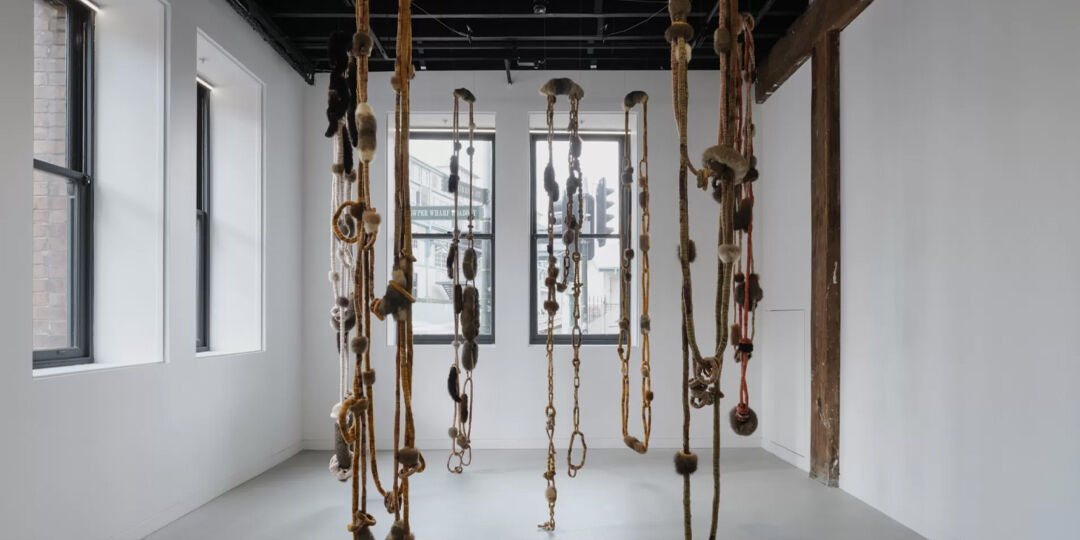
Juanita’s fellowship project, originally titled mulamula / soft or dhii / Tea and warmth. minyaarr / belong, was conceived as an immersive installation bringing together stories from regional New South Wales. The work explored belonging, family, Country, tea, warmth, possum cloaks and the blanket census through bush-dyed textiles, sound and large-scale installation.
The National Regional Arts Fellowship Program is a strategic project supported by the Australian Government Regional Arts Fund and delivered by Regional Arts Australia. Fellowships provide guaranteed income for regional artists and arts workers to develop work, skills, networks, or research.
At its heart, Juanita’s fellowship project was about connection.
Connection to family, Country, memory and the stories that live within materials.
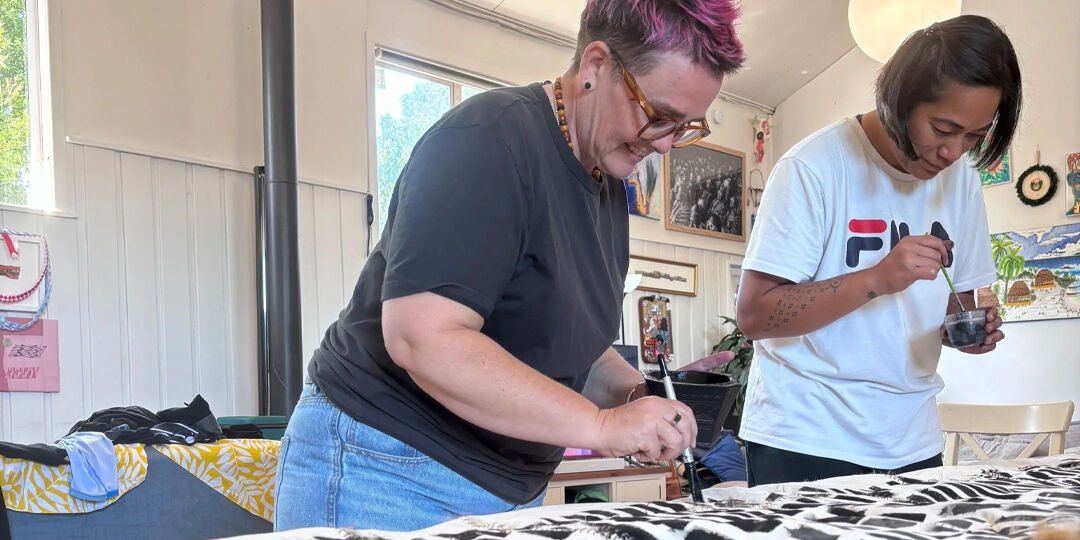
Juanita’s practice has always been grounded in making by hand. She describes coming from “a very hands-on family”, where her father taught her to weld when she was nine and her mother taught spinning, knitting and crochet.
“We’ve always had this constant movement of hands,” she says.
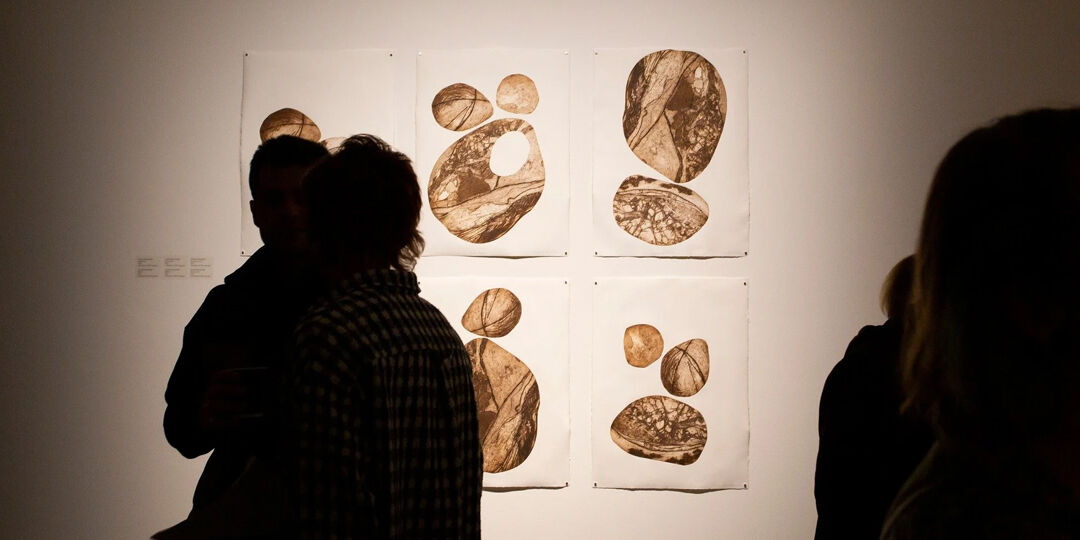
Printmaking was her first love, but over time her practice has expanded into textiles, possum skin, bush-dyed blankets, sound and installation. Through these forms, Juanita brings forward histories that have often been overlooked.
“In my work, I convey the story of family, and the forgotten history of who they were,” she says. “You can’t heal until you acknowledge what was broken, hurt, lost.”
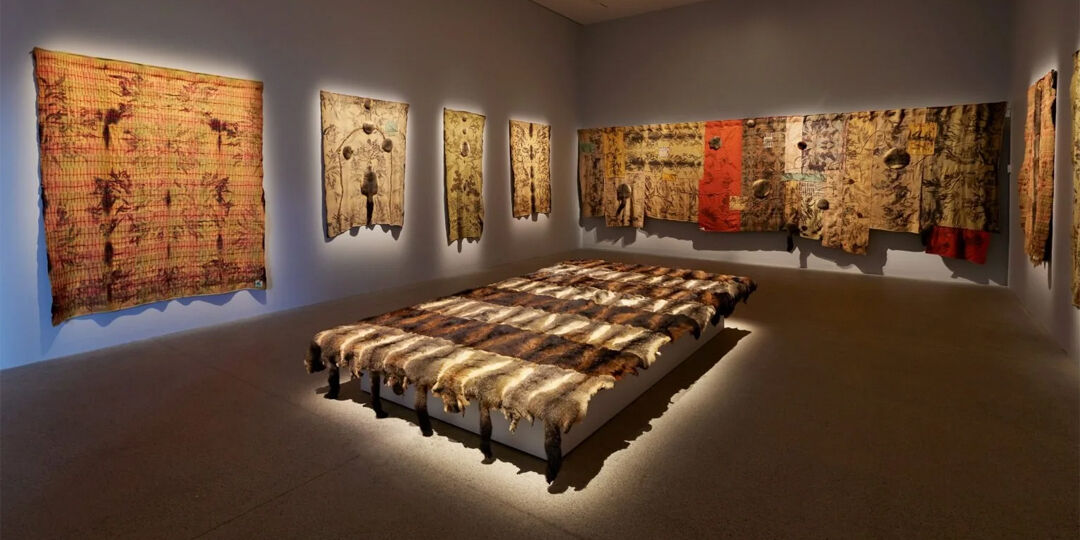
The fellowship gave Juanita the time and support to develop this work at a new level of scale. While her initial idea involved large tea bags suspended from the gallery ceiling, the project evolved through conversations with the Art Gallery of New South Wales into a major installation of blankets lining the gallery walls, with sound held within the space.
For Juanita, that change was part of the creative process.
“I don’t think you’re doing your art right if you plan it and stick to that plan,” she says. “You’re not being adventurous, you’re not challenging yourself, you’re not playing enough.”
The National Regional Arts Fellowship allowed her to play, experiment and take risks. It supported materials, sound development and the real costs of making ambitious work while balancing family, paid work and regional distance.
“The idea that I could actually have that financial support there only to do art was such a relief,” Juanita says. “It gave you that permission to produce.”
It also allowed her to work bigger than she had before.
“Without that funding I couldn’t have gone as big as I did, in size and scale, with producing my work.”
Juanita created the largest possum skin cloak or rug she had ever made, using 82 ethically sourced brushtail possums from Aotearoa. She also pushed her work to a seven-metre scale and incorporated sound recordings, including the Murrumbidgee River and heartbeats.
“My biggest thing was to experiment with sound… and work on scale as well,” she says. “I thought I knew I could go big, but I didn’t know I could go seven-metres big, and that was exciting.”
For an artist who describes herself as “very analogue”, working with sound opened a new direction.
“Being very analogue, doing something digital and different pushed me.”
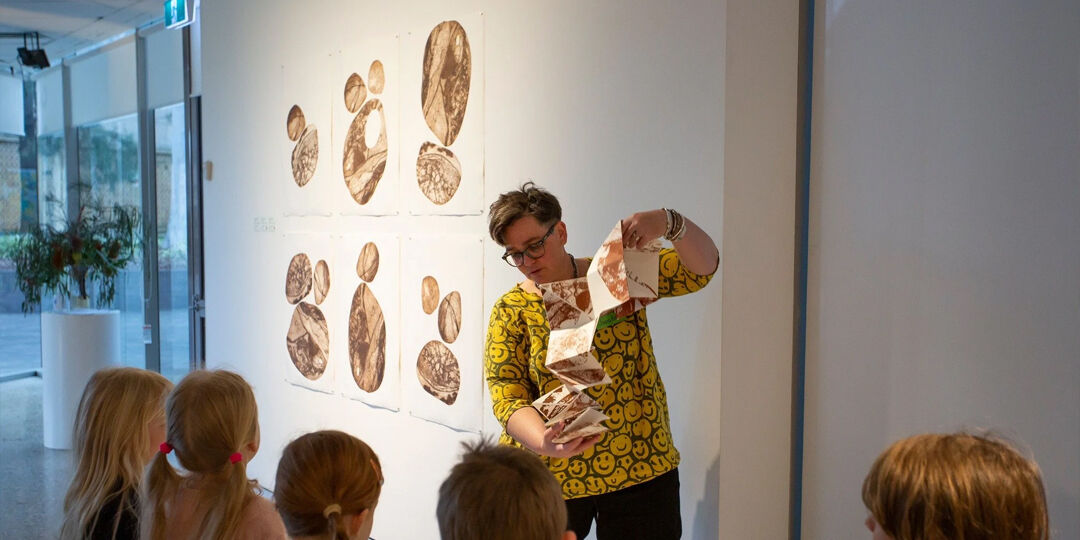
The final exhibition at the Art Gallery of New South Wales reached significant audiences, including gallery visitors, school groups and guided tours. Juanita reported more than 27,000 in-person visitors and 22,000 digital audience members.
“The amount of foot traffic, seeing your work, and people asking questions about your work and why you’re doing that… that was quite amazing,” she says.
Just as important as the audience numbers were the relationships formed through the project. Juanita worked with Cora-Allan, who shared a traditional Māori ink-making process during a residency in Aotearoa, she worked with Tim Crutchett and Damian Moloney from Evader Music, who helped shape the sound loop, worked with Dr Chris Orchard, who supported Gamilaraay language, and AGNSW curator Liam Keenan, whose support helped Juanita better understand the institutional context around presenting work in a major state gallery.
Since the fellowship, Juanita’s career has gathered momentum. She has been picked up by Cassandra Bird Gallery, had her work shown at Sydney Contemporary, been invited to speak at ART BYRON, and been approached for future exhibitions.
“I can’t tell you how much the fellowship and the exhibition [at the Art Gallery of New South Wales] has just opened doors,” she says.
For Juanita, the lesson has been to say yes.
“If you say no, doors shut straight away,” she says. “If you give it a go and be honest with yourself, it’s the opportunities you don’t realise you’re going to receive.”
One opportunity took her all the way to Paris, where she presented work at Art Paris with Cassandra Bird Gallery.
Juanita travelled internationally for the first time at that scale, a journey that took her far from Wagga Wagga, but never away from the family and histories that ground her work. Before travelling to Paris, her 90-year-old grandmother told her how proud the family was.
“My grandma’s 90, and she said, ‘Juanita, we’re so proud of you, we’re so excited that you’re going to Paris,’” Juanita shares. “I wasn’t alone, because all my family are with me, behind me. You never walk into a room by yourself.”
For Juanita, showing work of such personal, cultural and regional depth in a major state gallery and now internationally was a milestone. But she is clear that being a regional artist is not something she seeks to overcome. It is central to who she is and how she works.
“I love being regional. I couldn’t live in the city,” she says.
There are challenges: distance from major institutions, the planning required to travel, and the relative lack of constant access to exhibitions, galleries and networks. But there is also space, as Juanita believes, the space to be physical, creative and mental.
“It is isolating in the way that we are so far from a major city, but I think it gives you the opportunity to spread out and try,” Juanita says. “That’s the benefit of living regional. People, if they believe in you, they invest time and effort. But it’s a two-way street… you have to commit.”
That commitment is clear in the way Juanita describes her practice. The finished exhibition may be what audiences see, but the work itself is made in the margins of everyday life: around family, paid work, late nights, weekends and constant thinking.
“People only see you for that 10 seconds if you’re really good, but they don’t see the hours of time that go into it,” she says. “I don’t do art all the time. I work two days a week at TAFE NSW. I have family, we have five kids. I do it at home when I can, usually after my little girl’s gone to bed. I do it on the weekend.
“It’s a compulsion. You have to do it. You have to keep going.”
That sense of compulsion and carrying others, her family, ancestors, Country and story, runs through Juanita’s fellowship project and through the career it has helped propel. The National Regional Arts Fellowship supported the practical needs of making: materials, time, travel, sound and scale. But it also offered something less tangible and just as powerful, a validation in her work.
“It validated my work, that someone believed in my ideas. For me, that was probably more important than absolutely anything.”